Best Modified Acrylate Adhesive Types for Your Projects?
In the world of adhesives, "Modified Acrylate Adhesive" stands out for its versatility and strength. Dr. Emily Carter, a leading expert in adhesive technology, once said, "The right adhesive can redefine project efficiency." This statement resonates deeply in many industries where reliability is key.
Modified Acrylate Adhesive is particularly praised for its remarkable bonding capabilities across various materials. It excels in applications where resistance to environmental factors is essential. This adhesive type often surpasses traditional options, making it a favorite among professionals. However, not every project demands the same type of adhesive.
The selection process requires careful consideration. Users must weigh the specific needs of their projects against the characteristics of Modified Acrylate Adhesive. There are situations where it may not perform as expected. Some applications may benefit from alternative adhesives. Evaluating these factors is crucial for project success. In an industry that continually evolves, understanding these nuances is vital.
Types of Modified Acrylate Adhesives and Their Applications
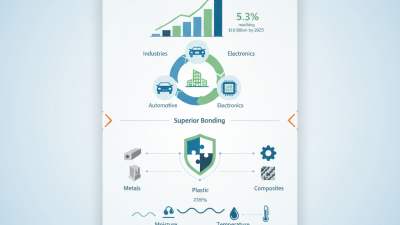
Modified acrylate adhesives have gained traction in various industries due to their versatility and bond strength. These adhesives are known for their durability and resistance to environmental factors. According to a 2021 industry report, the global market for modified acrylate adhesives is projected to reach $1.8 billion by 2025. This growth highlights their increasing importance in manufacturing sectors.
Different types of modified acrylate adhesives serve various applications. For instance, structural adhesives often perform well in automotive and aerospace industries, where weight reduction and high strength are crucial. A study indicated that these adhesives can withstand temperatures up to 150°C, making them ideal for high-performance applications. Other types, such as pressure-sensitive adhesives, find use in packaging and labeling due to their quick tack and ease of application.
Despite their benefits, using modified acrylate adhesives requires caution. Some formulations may have limited shelf life and may require specific handling conditions. Additionally, certain applications may not perform well if the surface preparation is inadequate. This could lead to imperfect bonding and decreased performance. As industries continue to innovate, understanding each adhesive's capabilities and limitations is essential for optimum results.
Key Properties of Modified Acrylate Adhesives
Modified acrylate adhesives have unique properties that make them suitable for various projects. They offer a balance of flexibility and strength, which is essential for bonding different materials. These adhesives cure quickly, reducing project downtime. Their resistance to environmental factors adds to their appeal.
When choosing a modified acrylate adhesive, consider the application. Some may perform better under stress, while others excel in temperature resilience. It's important to note that not all adhesives will provide the same results on every surface. Testing on a small area can help avoid unexpected failures.
Tips: Always prepare the surfaces thoroughly before applying the adhesive. Dust and moisture can weaken the bond. Also, check the adhesive's curing time. Rushing can lead to misalignment, which might ruin your hard work. Sometimes, adjustments are necessary after the initial application. Be patient and ready to reassess the situation as needed.
Best Modified Acrylate Adhesive Types for Your Projects? - Key Properties of Modified Acrylate Adhesives
| Adhesive Type |
Tensile Strength (psi) |
Curing Time (hrs) |
Temperature Resistance (°C) |
Viscosity (cP) |
Ideal Applications |
| Modified Acrylate A |
3000 |
2 |
70 |
200 |
Wood, Metal bonding |
| Modified Acrylate B |
3500 |
1.5 |
80 |
150 |
Plastic, Composite materials |
| Modified Acrylate C |
4000 |
3 |
90 |
100 |
Rubber, Automotive applications |
| Modified Acrylate D |
2800 |
2.5 |
75 |
250 |
Construction, Electronics |
Choosing the Right Modified Acrylate Adhesive for Your Project
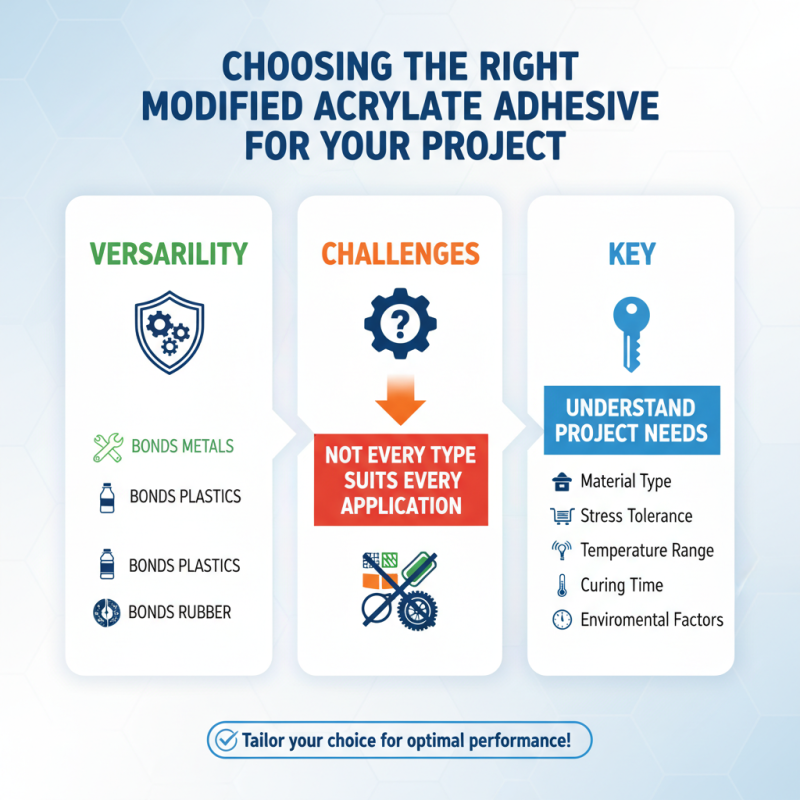
Choosing the right modified acrylate adhesive for your project can be challenging. These adhesives are known for their versatility. They bond various materials like metal, plastic, and rubber. However, not every type suits every application. Understanding specific project needs is key.
Consider the environment where the adhesive will be used. Will it face moisture or extreme temperatures? Some modified acrylate adhesives perform poorly in humid conditions. You might find they lose strength over time. Testing a small sample can save a lot of hassle later.
Also, think about the curing process. Some adhesives cure faster than others. If time is tight, a quick-setting option might be better. But if you need a strong, lasting bond, a slower-curing adhesive might be worth the wait. Evaluate your project's requirements carefully. Avoid rushing into a decision. Experimentation often helps discover surprising results.
Installation and Curing Techniques for Modified Acrylate Adhesives
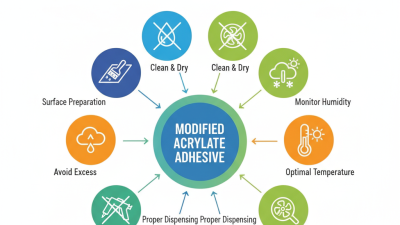
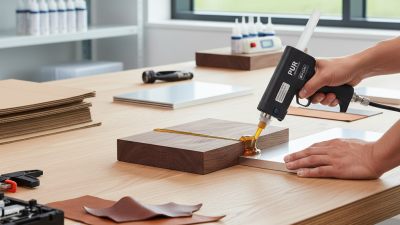
When working with modified acrylate adhesives, installation is crucial. Prepare your surfaces well. Clean them thoroughly to remove any dust or oils. This ensures maximum bonding strength. Applying the adhesive evenly is key. Use a suitable applicator for the job. Avoid globs or thick layers. They can weaken the bond.
Curing is equally important. Many modified acrylate adhesives cure quickly. However, patience is still essential. Allow ample time for full curing. This usually takes a few hours but can vary. Maintain proper temperature and humidity for optimal results. High humidity can interfere with the curing process.
**Tips:** Use a timer to track curing time. Keep your work area clean and organized. Always check the adhesive setting periodically. If the bond seems weak, consider redoing the application. Practice on scrap materials first. This will help refine your technique.
Best Modified Acrylate Adhesive Types for Your Projects
Common Use Cases and Industries for Modified Acrylate Adhesives
Modified acrylate adhesives are widely used in various industries due to their flexibility and strong bond strength. These adhesives excel in applications requiring durability and resistance to environmental factors. You might find them in electronics, where they bond components securely. Their rapid curing times are helpful in fast-paced manufacturing.
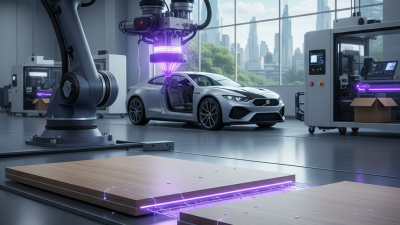
In the automotive industry, modified acrylate adhesives are essential. They help assemble parts quickly while providing resistance to heat and moisture. The flexibility of these adhesives allows them to absorb vibrations, which is crucial for vehicle longevity. However, users need to consider their limitations, such as curing conditions. Mistakes can happen if the wrong ratios are mixed.
These adhesives are also common in the construction sector. They are used for joining different materials, from metal to plastics. Their application can vary, but they shine where strong, lasting bonds are needed. Still, it’s important to test their performance over time, as changes in temperature may affect adhesion. Overall, modified acrylate adhesives are effective solutions, but some challenges require attention and reflection from users.