What Are the Best SBS Adhesives for Global Procurement?
SBS adhesive stands as a beacon in the world of industrial bonding. Its versatility makes it a favored choice among procurement professionals. Companies rely on SBS adhesive for various applications, including construction, automotive, and electronics. However, selecting the best options requires careful consideration.
In global procurement, understanding the unique properties of SBS adhesives is crucial. This material offers excellent flexibility and durability. Despite its benefits, there are challenges. Different suppliers may not provide the same quality. Variability in formulations can impact performance.
Evaluating the best SBS adhesives involves assessing factors like adhesion strength and environmental resistance. Companies must also consider availability and delivery times, as these can affect production schedules. Browsing through suppliers, one might often wonder about material certifications. Balancing cost and reliability becomes a complex task.

Overview of SBS Adhesives and Their Applications
SBS adhesives, or Styrene-Butadiene-Styrene adhesives, are widely used in various industries. They create strong bonds and provide excellent flexibility. These adhesives are ideal for applications in construction, automotive, and packaging sectors. Their ability to withstand changing temperatures makes them a popular choice for outdoor use.
In the construction industry, SBS adhesives are used for flooring and roofing materials. They help secure tiles and membranes, ensuring long-lasting performance. In automotive assembly, these adhesives bond parts effectively while allowing for movement. However, the effectiveness can depend on surface preparation and application conditions. Factors like humidity and temperature often impact performance.
In packaging, SBS adhesives enhance the durability of seals and labels. They ensure that products remain secure while also being easy to open. Despite their advantages, some users report challenges in application processes. Finding the right balance between adhesion strength and workability can be tricky. Manufacturers should provide guidance on best practices, but variations in environments may still yield unexpected results. These complexities encourage continuous learning and adaptation in the use of SBS adhesives.
What Are the Best SBS Adhesives for Global Procurement? - Overview of SBS Adhesives and Their Applications
| Application Area |
Type of SBS Adhesive |
Features |
Temperature Resistance (°C) |
Viscosity (cP) |
| Automotive |
Hot Melt Adhesive |
High strength, quick setting |
-40 to 120 |
3000 |
| Construction |
Solvent-Based Adhesive |
Excellent flexibility, weatherproof |
-30 to 100 |
2500 |
| Footwear |
Water-Based Adhesive |
Eco-friendly, low odor |
-20 to 80 |
1500 |
| Electronics |
Conductive Adhesive |
Electrical conductivity, heat resistance |
-40 to 150 |
5000 |
Key Factors in Choosing SBS Adhesives for Global Procurement
When selecting SBS adhesives for global procurement, several key factors come into play. Quality assurance is paramount, as variations in formulation can lead to inconsistent performance. According to a recent industry report, nearly 30% of procurement issues stem from adhesive quality discrepancies. Suppliers must demonstrate rigorous testing and certification to assure reliability.
Another important factor is environmental compliance. Many regions have strict regulations on volatile organic compounds (VOCs). Non-compliance can result in significant penalties. It’s vital to choose SBS adhesives that meet eco-friendly standards, ensuring safety and sustainability throughout the supply chain. Data indicates that 40% of companies prioritize sustainable products in their procurement processes.
Cost efficiency is also crucial. While lower-priced adhesives may seem appealing, they can lead to higher long-term expenses due to poor adhesion and higher failure rates. An analysis showed that companies spending on higher-quality SBS adhesives experienced 25% fewer production delays. Ultimately, a thorough understanding of these factors can lead to more effective procurement decisions.
Top Brands of SBS Adhesives: A Comparative Analysis
SBS adhesives are widely used across various industries due to their
strong bonding properties and flexibility. When considering top brands of SBS adhesives, key aspects include their formulation, performance, and application methods.
Several manufacturers offer distinct features that cater to specific needs in procurement.
When analyzing different brands, it's crucial to test the adhesion quality
on various surfaces. Some adhesives bond well with plastics but may falter on metals.
Always review the curing time as it can impact project timelines.
Tip: Conduct small-scale tests before committing to large orders.
Evaluate performance over time to ensure durability.
It's essential to consider how environmental factors affect adhesive performance.
Some adhesives may degrade when exposed to moisture or heat.
When selecting an SBS adhesive, think about long-term use and application environment.
Tip: Regularly check for updates on adhesive technologies.
Advances can improve reliability and performance.
Remember, not every adhesive suits every application. Reflect on past experiences
with bonding failures. Adjust your choices based on thorough evaluations.
Regulatory Considerations for SBS Adhesives in Global Markets
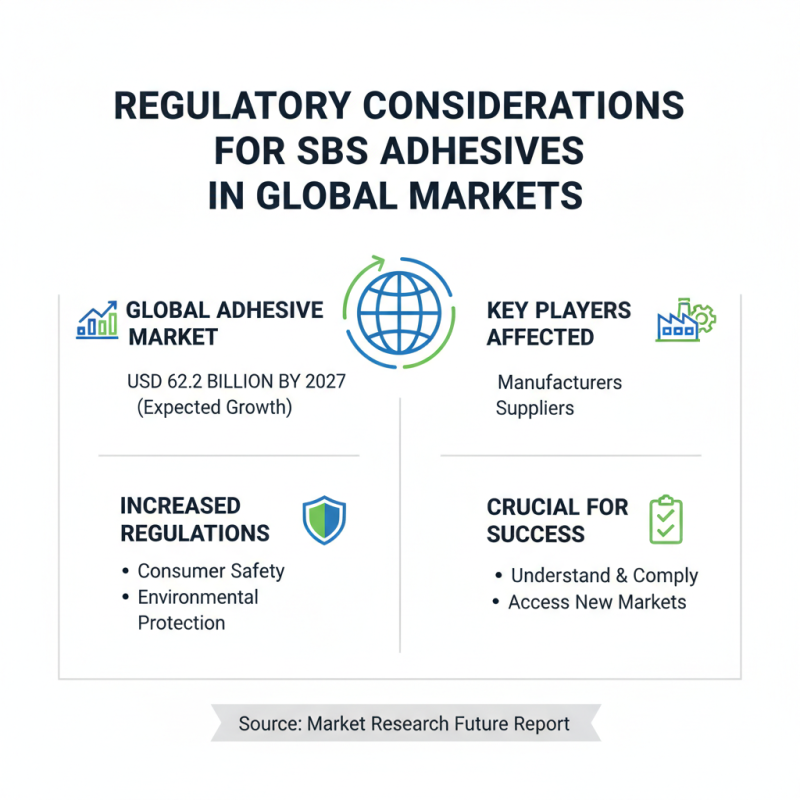
When considering SBS adhesives for global procurement, regulatory requirements play a significant role. The global adhesive market is expected to reach USD 62.2 billion by 2027, according to a report by Market Research Future. With this growth, countries have implemented stricter regulations to ensure consumer safety and environmental protection. Understanding these regulations is crucial for manufacturers and suppliers.
In the European Union, SBS adhesives fall under stringent VOC regulations. Maximum allowable limits for volatile organic compounds are often set to minimize environmental impact. Conversely, in the Asia-Pacific region, regulations may vary significantly between countries. This divergence requires careful navigation to ensure compliance in multiple markets. A recent study highlighted that 58% of businesses faced compliance challenges due to differing regulations.
Non-compliance can lead to costly repercussions, including product recalls and financial penalties. Companies must invest in understanding the regulatory landscape to mitigate risks. The road ahead is complex; staying informed and adaptable is essential. Without proactive measures, companies may find themselves struggling to enter lucrative markets.
Future Trends in SBS Adhesive Development and Procurement Strategies
The future of Styrene-Butadiene-Styrene (SBS) adhesives highlights a dynamic landscape shaped by innovative technologies and global market needs. Recent studies indicate that the global SBS adhesive market is projected to grow at a CAGR of around 5.8% from 2023 to 2030. This growth is driven by expanding demand in the construction and automotive sectors. These industries increasingly rely on SBS adhesives for their excellent bonding performance and flexibility.
Emerging trends point to a strong emphasis on sustainability. Many manufacturers are now exploring bio-based adhesives and eco-friendly formulations. A report from a leading industry analysis firm revealed that by 2025, over 30% of new SBS adhesive products will focus on reducing environmental impact. However, the challenge remains in balancing performance with sustainability. Some traditional formulations still dominate due to their reliability, making a transition difficult.
Supply chain dynamics are also evolving. Recent disruptions have highlighted the need for more robust procurement strategies. Procurement professionals must adapt to navigate volatile material costs and identify reliable suppliers. Transparency in the sourcing process is becoming increasingly critical. Companies are encouraged to conduct thorough due diligence when selecting suppliers, ensuring a stable supply chain while maintaining quality and compliance standards.